While others took to social media to send memories and condolences of our beloved Mary Pat Clarke, I took a couple of days to process her loss and the incredible impact she had on this city and on me. I have known MPC for the entire 20 years that I have lived in Baltimore City. Our relationship began with her as my professor at Johns Hopkins University in 2004 when I decided that I wanted to make Baltimore City home. I knew nothing about the city other than the job I came to weekly at Johns Hopkins University’s Athletic Department. I wanted to learn more, so the class,” American Cities: Baltimore” gave me the insight I needed plus so much more: the journey of city life and public service.
MPC became a resource to me as I stumbled through the nuances of city life. First it was as a volunteer for her campaign for council, then it was much needed guidance as I navigated the city process as a community association president and then a board member with Waverly Main Street. She would continue to be a mentor through the process of applying to work for the city under then City Council President Bernard C. “Jack” Young. When I thought I wanted to be a lawyer, MPC wrote a letter of recommendation but told me that I did not need to be a lawyer to change and impact policy. And when I was recruited to run for the Baltimore Central Committee, she was one of two mentors who suggested that I run for state delegate. MPC was right . . . she was often always right. MPC was always supporting others, lifting others, nurturing others, pushing others, and gave so many of us opportunities and experiences that have placed us in the positions we are in today. She was a lover of the underdog, and there was no fight she backed down from. MPC was one of a kind.
Through my time as an elected official, I have modeled her standard of public service, which is not easy. She made public service look so easy, so effortless, so dignified. Public service is not easy, it takes a ton of effort, but it is certainly dignified, and I am honored to be in this service. She made public service admirable, and I followed her example. I am doing my best, but I am not MPC. Her life, her service, was exemplary, one that needs more than a willing desire, but tenacity, grit, fearlessness, passion, compassion, and a touch of endurance from above. Her life and work are a legacy in Baltimore, one that we will remember for decades, centuries. I want to thank Mary Pat for making me a lover of Baltimore, a fighter for Baltimore, and a proud public servant of the greatest city in America.
Rest in Heaven, Professor, Council President, Councilwoman, Mentor, Mary Pat Clarke.
Delegate Regina Boyce
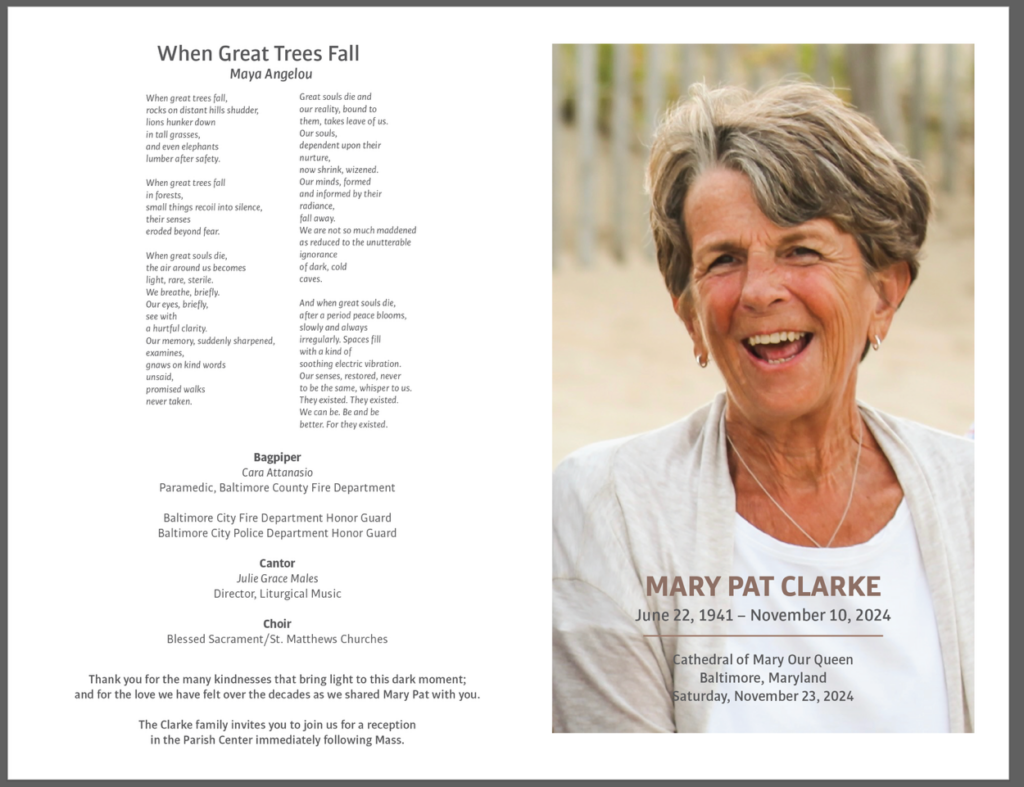
Mary Pat Clarke Obituary
We are thankful for The Banner for their printed obituary for Mary Pat. You can read it with the link below.
A funeral mass will be held at the Cathedral of Mary Our Queen on Saturday, November 23, at 10:30 a.m. with a reception to follow immediately afterward.
In lieu of flowers, donations in memory of Mary Pat can be made to a community-based charity of your choice.
To plant trees in memory, please visit the Sympathy Store.
1975
In the Spring of 1975, a Cloverhill Road mother loaded her youngest daughter into a stroller and began knocking on doors in the 2nd City Council District. She had just spent the previous years leading the Greater Homewood Community Corporation, an umbrella coalition of neighborhoods surrounding Johns Hopkins, working to establish Action In Maturity (AIM), strengthen our schools, and organizing the City Fair. That young mother was Mary Pat Clarke. With the help of many Tuscany Canterbury residents such as the Eberharts, Chafants and O’Briens, Mary Pat was successful. Forty five years ago, she was sworn into the Baltimore City Council.
It was an exciting time to be on the Council. She joined another community resident, Barbara Mikulski who would soon launch her City Council role into a run for the United States Congress. They were a dynamic duo! From shaping the debate on Harbor Place, to rent control, or passing residential permit parking and tenants right of first refusal, Mary Pat was an immediate and tremendous success.
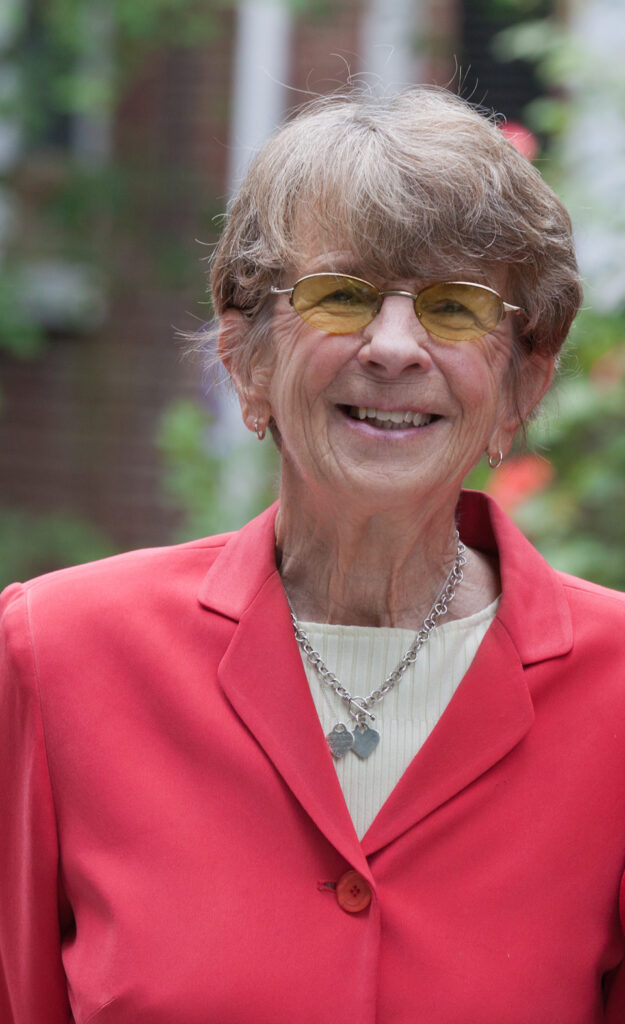
Mary Pat Clarke
In the Spring of 1975, a Cloverhill Road mother loaded her youngest daughter into a stroller and began knocking on doors in the 2nd City Council District. She had just spent the previous years leading the Greater Homewood Community Corporation, an umbrella coalition of neighborhoods surrounding Johns Hopkins, working to establish Action In Maturity (AIM), strengthen our schools, and organizing the City Fair. That young mother was Mary Pat Clarke. With the help of many Tuscany Canterbury residents such as the Eberharts, Chafants and O’Briens, Mary Pat was successful. Forty five years ago, she was sworn into the Baltimore City Council.
It was an exciting time to be on the Council. She joined another community resident, Barbara Mikulski who would soon launch her City Council role into a run for the United States Congress. They were a dynamic duo! From shaping the debate on Harbor Place, to rent control, or passing residential permit parking and tenants right of first refusal, Mary Pat was an immediate and tremendous success.
She served in the Council from 1975-1983 and as City Council President from 1987-1995. She was the first woman ever elected citywide and was lead sponsor of the nation’s first “Living Wage” law. In 2004 Mary Pat ran an unsuccessful campaign for Mayor.
When Baltimore voters approved single-member City Council districts, Mary Pat ran again for office. In November of 2004 she was sworn into office in the newly created 14th District. Here we are sixteen years later, and Mary Pat has decided it is time for a new generation to fill her shoes on the Baltimore City Council.
We will miss her! What we will miss the most is really her greatest talent and accomplishment: Mary Pat has just shown up, answered our calls, stopped by our homes, and listened to us for the past forty plus years. She is known for her attention and caring for every constituent call or need. We have all seen her at our neighborhood meetings or just on the street with her trusted 3×5 note cards, taking every detail of our stories or complaints. Helping us, helping our neighborhood is just in her DNA.
Another Mary Pat Neighborhood Memory
My favorite Mary Pat story (which I hand-wrote on the newsletter but my handwriting being what it is, thought I should also type): Some years ago during a water main break, which necessitated a giant hole being dug in the middle of Tuscany Road, I walked down to it to see if the crew knew when water might be restored, and there’s Mary Pat up to her neck in the hole, checking progress. “Wow,” I said to her, “getting muddy!” “I do this a lot,” she said.
If constituent services is any measure of a councilperson’s effectiveness then there is little debating that Mary Pat Clarke had a long and successful career. I once spoke to Mary Pat Clarke and mentioned that I had seen this recipe, for “Fudge-It,” in “Good things are Cooking in Greater Homewood,” a cookbook produced in 1973 by the GHCC. She professed to not be much of a cook. I have to admit this fudge recipe isn’t the most magical, fudgey candy around, but hey – its in the name.
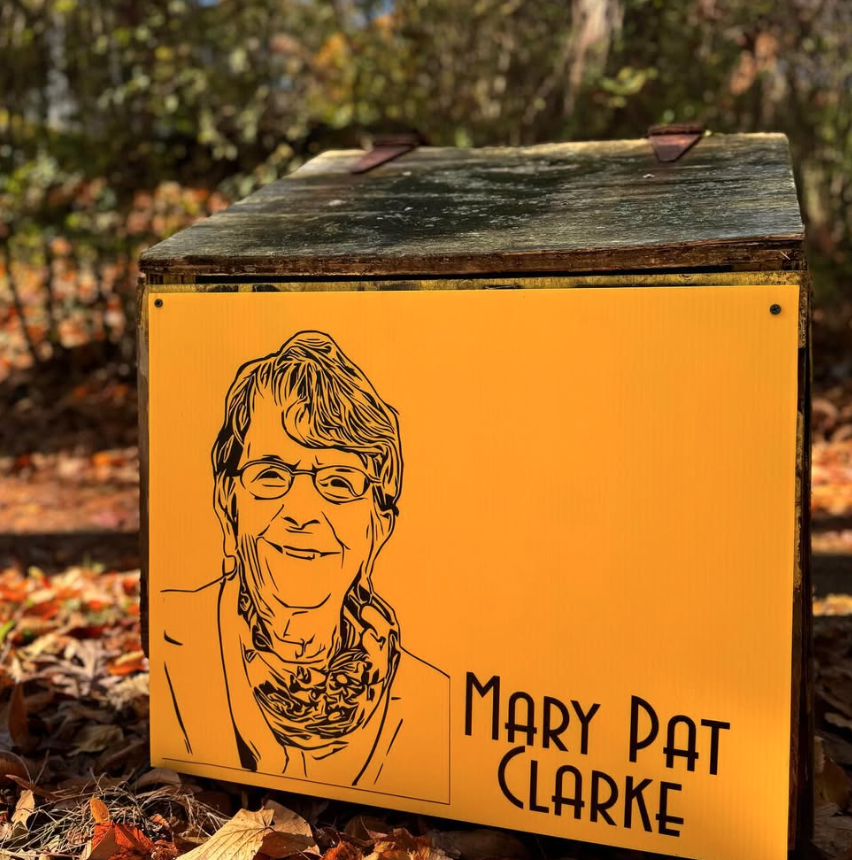
Salt Box Mary Pat Clarke
Salt Box
“Not how I wanted to kick off Salt Box Season, but no one deserves the first box of the season like Mary Pat Clarke. This trailblazing Baltimore City Council member of 32 years (and eventually first female president of the council) passed away Nov 10. I had the pleasure of being in a few merchant meetings with her, and her civic pride and tenacity were contagious! I always left those meetings feeling inspired.”
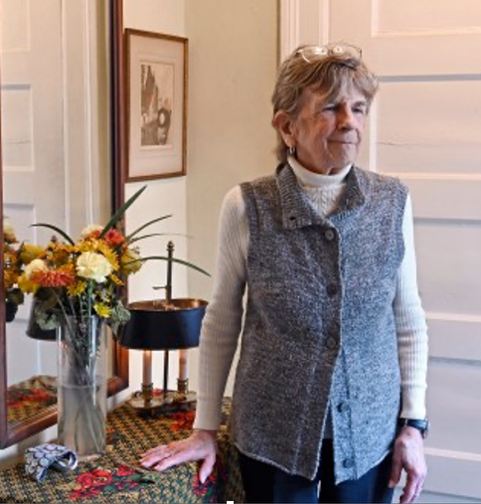
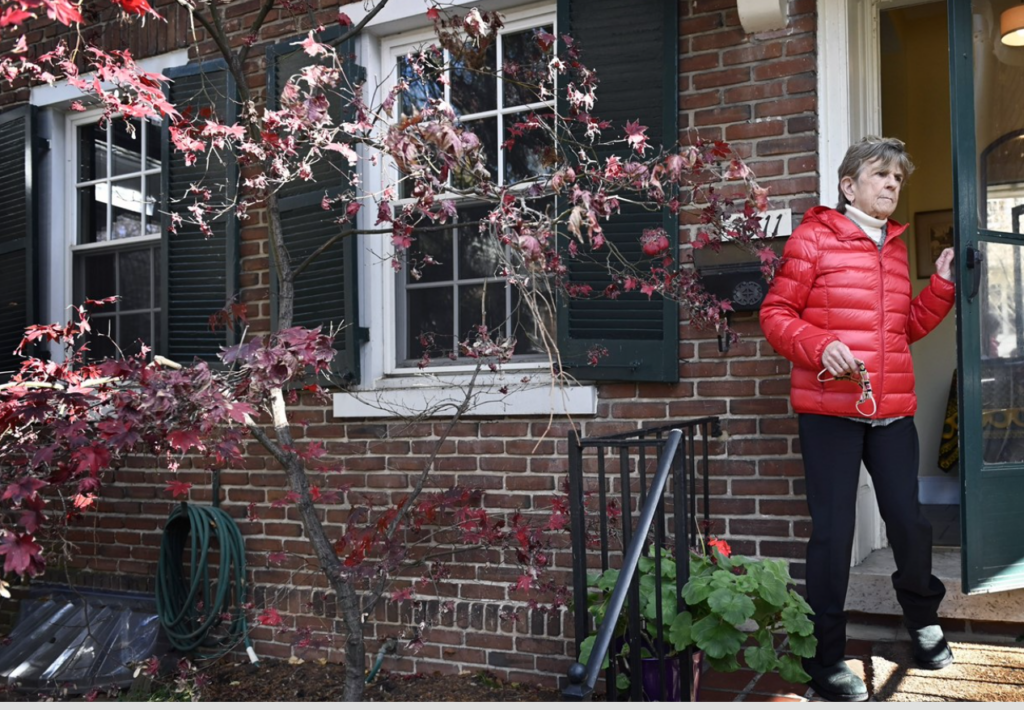
Mary Pat, at home
Baltimore Sun Commentary November 12, 2024
Baltimore needs more like Mary Pat Clarke | STAFF COMMENTARY
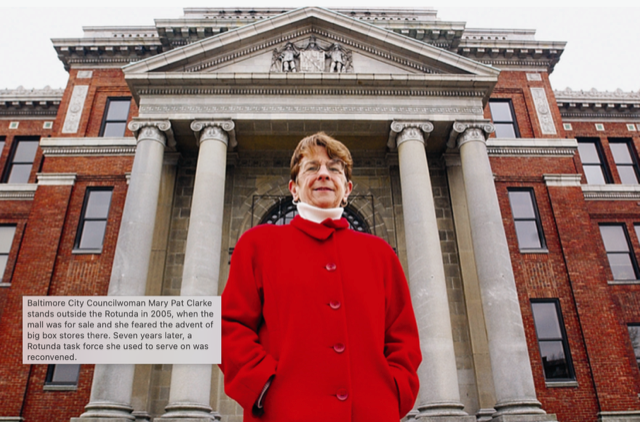
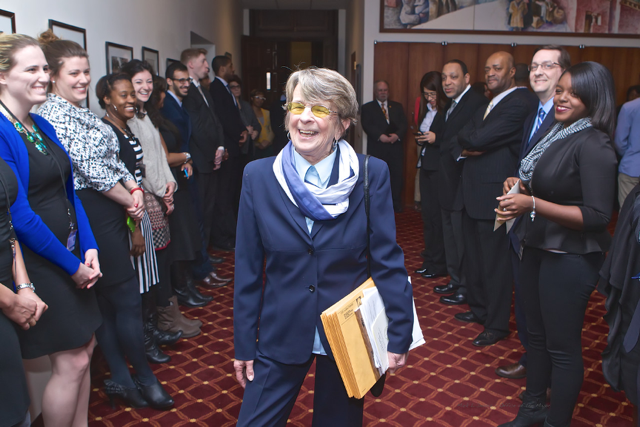
Mary Pat Clarke retired in 2020 after serving more than 20 years on the Baltimore City Council beginning in 1975 (1975-1983; 1987-1995; and 2004 to 2020)
It is entirely fitting that the city-owned playground at Lake Montebello is officially known as the Council President Mary Pat Clarke Playground, not simply because of her lengthy career in public service — a staggering 32 years on the Baltimore City Council, including eight as council president, before stepping down in 2020 — but because of the high-energy, family-oriented fun one associates with playgrounds. Clarke, who passed away Sunday at the age of 83, will long be remembered as a pioneer for women in politics but she should also be celebrated for her empathy, her ability to understand and share the feelings of the people around her. She cared about people and it showed.
We live in a deeply cynical age and we do not offer the longtime teacher as some kind of perfect politician if there is such a thing. But where she did set the standard was in having a genuine concern for the welfare of Baltimoreans. She sought progress — not necessarily as measured by profit but perhaps by simply doing right by more people. She was short in stature but tall in moral bearing. And boy, did she have a deep reservoir of energy. Reporters never struggled to elicit a strong opinion from Mary Pat Clarke, especially if she saw a wrong to be righted.
It made perfect sense that Clarke was a contemporary of fellow Democrat Barbara Mikulski who served with her on the council at one time before being elected to the U.S. House of Representatives and eventually the U.S. Senate. Both were plain-spoken, short in stature but dynamic in presence. Mikulski on Sunday credited Clarke for helping mentor the next generation of leaders. We wonder how many of us learned from Clarke in some way. You didn’t need to be an aspiring politician to appreciate her humor and warmth.
Finally, we feel a little sorry for those who never got a chance to meet this one-of-a-kind Baltimorean. We would simply tell newcomers this: You know the button-down type of pol who hides behind platitudes and focus groups, relies on aides to do the heavy lifting and keeps her speeches carefully scripted? Who regards public service as a bit of a con? Good, now think of the opposite. That was Mary Pat Clarke.
Dan Rodricks: Everyone called her Mary Pat, an energetic public servant and proud progressive Democrat | STAFF COMMENTARY, Baltimore Sun
When, at age 61, Mary Pat Clarke decided to return to public life — that is, when she launched a campaign to run again for a seat on the Baltimore City Council, where she had served several years earlier — she did so to guarantee that someone would answer the phone.
She wanted to make sure that Baltimore’s new 14th District would be represented by someone responsive to the people who lived there. Mary Pat Clarke lived there, forever on Cloverhill Road, and she thought the best person for the job was Mary Pat Clarke.
In 2002, Baltimore had switched from six three-member council districts to 14 single-member districts. Clarke, who had served under the previous system in the 1970s and 1980s, knew that serving constituents well was a 24/7 job. She worried that, with single-member districts, Baltimoreans could get stuck with a real loser of a council member.
That’s why I ran again and got back into elected office, because all of a sudden [we had] single-member districts,” she said. “And I said, ‘Hey, I’m either going to be on hold for four years trying to reach somebody or let me run and see if I can work for the district.’”
“I am useful at times. I try to be.”
Voters approved, and Clarke served another 17 years on the council. She knew and helped thousands of people. By the time she retired in 2020, she had given more than three decades of robust service to the people of Baltimore.
Clarke, who died Sunday at 83, was one of the most popular members of the council. Everyone called her Mary Pat. She was an energetic, positive and practical city politician, a proudly progressive Democrat who believed in Baltimore and helped it recover from the devastating riots of 1968. We had something in common: We were both born in New England, both moved to Baltimore and adopted the city as our new hometown.
“We moved around a lot, my family and I, when I was a kid, and I wanted my children to grow up so that when someone asked, ‘Where are you from?,’ they would know right away what the answer was,” Clarke told me in 2016, when she ran for her final term on the council.
She and her husband, Joe Clarke, settled in Baltimore in the 1960s and raised their family of three daughters and a son. “We put down roots and never wanted to leave,” she said.
Mary Pat Clarke became a founding member of Greater Homewood Community Corp. in an effort to help the city recover from the riots that had devastated businesses and homes — and the city’s psyche — following the assassination of the Rev. Martin Luther King Jr. in April 1968. She was among the deeply invested Baltimore citizens who helped establish the City Fair in 1970 as a way to bring people across the city together and to relieve anxiety among all others about coming downtown again.
“When the riot was over, the mayor [Thomas J. D’Alesandro III] was devastated and everything went still,” Clarke recalled. “And all of us out here in the neighborhoods had to reach out to each other. We didn’t know each other.”
Neighborhoods were segregated by race, by ethnicity, by fear.
“All of a sudden, “Clarke said, “we realized that the city was our neighborhood. It was the city we needed to be working for.”
Despite a rainstorm that blew down some of the neighborhood booths that had been set up in Hopkins Plaza, the first fair, in 1970, was a striking success. “The rainstorm messed it up, but everyone helped everyone get their booths back together,” Clarke recalled. “At the time, the notion of going downtown was verboten. But we went downtown. People came.”
She first ran for city council in 1975, in the old 2nd District; she ran with two Black candidates, Nathan Irby and Clarence “Du” Burns, keeping the ticket for that district racially integrated.
In 1983, Clarke ran citywide for City Council president and lost to Burns. She worked for a few years in geriatric medicine before taking another run at the council presidency.
The second time, in 1987, she was victorious, becoming the first woman to hold that post. She was council president for two terms before challenging Mayor Kurt Schmoke in the 1995 election. She lost. “I said, ‘Enough already,’” Clarke said. “My real profession was teaching. I was an English teacher, teaching undergrads at Hopkins and UMBC. I wrote a course about cities, a sociology course, for the Maryland Institute [College of Art] to help creative students understand that they can be change artists for urban societies … a force for change.”
The course focused, in part, on how urban spaces should be designed to best serve the people who live there.
People, after all, was what Clarke said motivated her to run for office and advocate for living wages for city workers and municipal employees, more affordable housing, the eradication of lead paint in old homes and the removal of blighted properties.
She dropped teaching to run for office again in 2003, to make sure someone answered constituents’ phone calls.
“I never teach and represent people at the same time,” she said. “Everything you’re thinking about is always either with your students or with your constituents. I can’t get them mixed up. I don’t do that well.”
The people of the 14th District, covering large parts of central and north Baltimore, welcomed her back.
“It’s such a great district,” said Mary Pat. “It’s the most progressive, activist district in the city. Sometimes I just take orders [from demanding constituents]. But I love that. I shouldn’t say I like people yelling at me — I don’t want to give anyone any ideas — but it shows spirit. ‘Let’s go!’ There’s still so much to do.”

 OLD LINE PLATE